
A city name on a map is legible to anyone who glances at it. A pair of coordinates is not — it looks like a string of numbers until someone decides to type it into a search bar and find out what it points to. That difference is the entire case for using coordinates instead of, or alongside, a named marker: it turns a detail on your map from something everyone reads at a glance into something only a curious person discovers.
Why coordinates work differently than a name
People who get coordinates tattooed onto themselves run into this same tension: a string of numbers on someone's skin can read as strangely cold, even alarming, out of context, until you know what it is. But that same quality — illegible at a glance, meaningful once decoded — is exactly what makes coordinates work as a private code on a gift rather than a public label. A visitor who reads "Lisbon" on your map immediately knows what it means. A visitor who reads "38.7223° N, 9.1393° W" has to be curious enough to look it up before it means anything at all, and by the time they have, they have effectively asked you to tell them the story. The city name announces the place. The coordinates invite the question.
Getting them right
Precision is the only part of this that can actually go wrong, so it is worth doing properly. Decide between two formats before you send anything: decimal degrees (38.7223, -9.1393) or degrees-minutes-seconds (38°43'20"N 9°08'21"W) — both are correct, but pick one and state it clearly rather than mixing them. To find the exact coordinates of a specific address, restaurant, or landmark, a quick search for "[place name] coordinates" or dropping a pin on any mapping app will give you the precise figure, usually to four or five decimal places, which is more than enough accuracy for the location to be identifiable once someone looks it up.
Where coordinates fit on a map that is already about a place
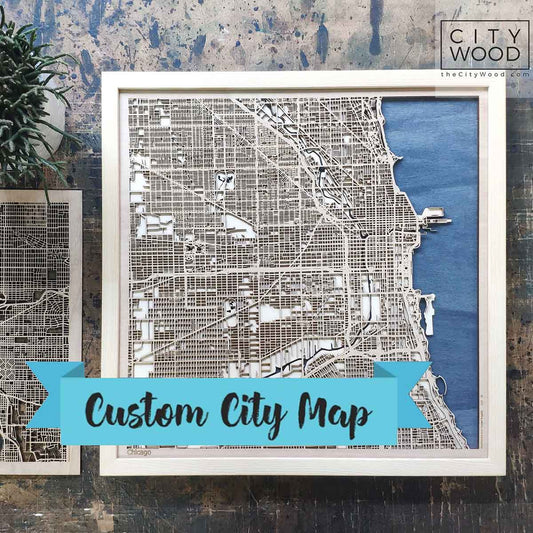
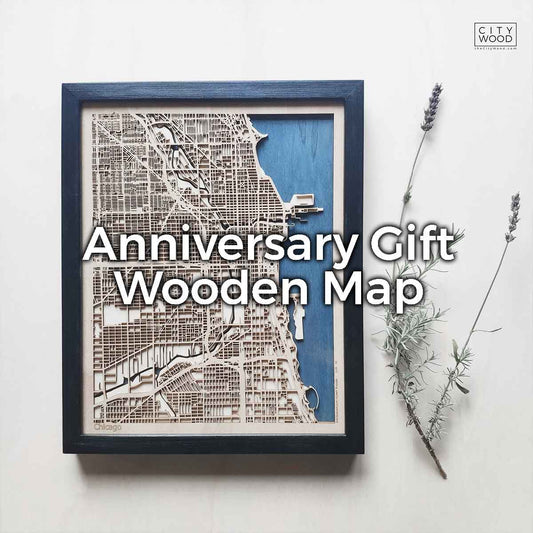
A wooden map already represents a location through its streets and geography, so coordinates are not a replacement for the map itself — they are a specific, technical way of noting one point within it, most often used as an engraved detail rather than the marker itself. If you want the location visually marked on the front of the piece, that is what an icon does; see Heart, Star, or House Pin? Best Markers for Anniversary Wooden Maps for how to choose one. Coordinates tend to work best engraved as text, most naturally on the back alongside or instead of a written message — see Front vs Back Engraving: What to Write on Your Wooden Map for how the front and back are typically split. The two are not competing choices: a heart marker showing where it happened on the front, and the exact coordinates of that same spot engraved on the back, is a natural pairing rather than a redundancy.
For the couple who thinks in data, not just sentiment
Coordinates tend to appeal to a specific kind of couple: the ones who would rather engrave an exact, verifiable fact than a phrase, who find precision more romantic than adjectives. If "the exact spot" matters more to you than "a nice way of putting it," coordinates are probably the right format before you have even finished reading this. They also travel well across formats — the same coordinates that mean something on a wooden map work equally well on a smaller keepsake, which makes them a useful detail to settle once and reuse.
FAQ
Do coordinates replace the city marker, or go alongside it?
Either works. Some couples use coordinates instead of a named marker for a more private, decoded feel; others keep a visible icon on the front and add the exact coordinates as an engraved detail on the back.
Decimal degrees or degrees-minutes-seconds — does it matter which we use?
Not for accuracy, only for clarity. Pick one format and tell us clearly which it is so it can be engraved correctly.
How precise do the coordinates need to be?
Four to five decimal places in decimal degrees (or the equivalent in DMS) is enough to pinpoint a specific address or exact spot, not just a general area.
Can coordinates be used instead of an address for a two-location map?
Yes. Coordinates for each location work the same way an address does — send us both and we will confirm placement.
What if we do not know the exact coordinates of the moment, only the general area?
Use the coordinates of the closest identifiable point — the venue, the street corner, the building — rather than leaving it approximate. A specific nearby point works better than a rounded, vague one.
Once you have your coordinates and a format decided, send them along with your city. Start your commission and Hubert Roguski, architect and designer, will confirm exactly how they read on the piece before anything is cut.